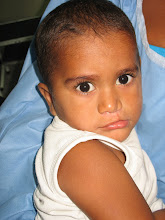
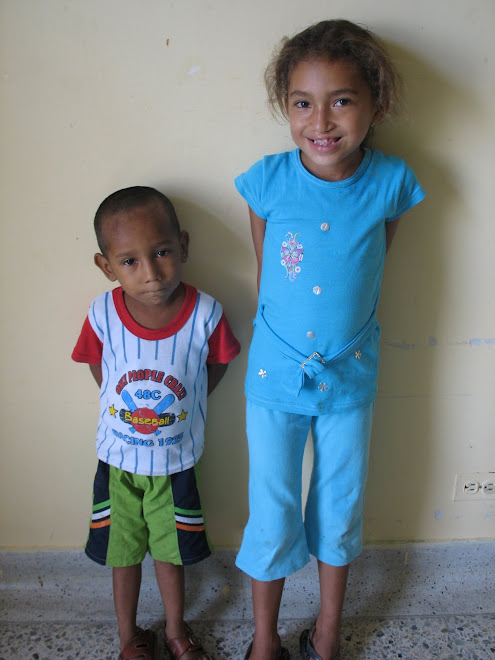
They wait in a bare hallway--often for hours--for surgery. Although they have not eaten all day and there are more patients than chairs, I receive lots of happy holas.


She got the name "The Lady with the Lamp" from a phrase in a report in the Times that said:
She is a ‘ministering angel’ without any exaggeration in these hospitals, and as her slender form glides quietly along each corridor, every poor fellow's face softens with gratitude at the sight of her. When all the medical officers have retired for the night and silence and darkness have settled down upon those miles of prostrate sick, she may be observed alone, with a little lamp in her hand, making her solitary rounds.


When I tell my friend who works in international affairs that I am in Colombia, he sends me a report.
My friend works for the International Rescue Committee, an international humanitarian aid organization organized in 1933 by Albert Einstein to help those in opposition to Nazism. The IRC has supported numerous persecuted or displaced groups due to ethnic conflicts, war, or environmental crises.
From a February 11 Reuters article on Colombia:
although it's exactly that order the guerillas have been fighting against for 40 years. The original demands of the guerillas were threefold: land reform, state administration of resources, and social reforms. But because they've employed tactics like kidnapping, child soldiers and landmines, they've undermined their legitimacy.
Drug ProductionFrom Susan Lang at ChronicleOnline, Cornell University:
Cornell graduate student Niousha Roshani works with displaced children in Colombia. Roshani, who interviewed displaced families in Colombia and then scoured many sources to assess the extent of the problem, said that warfare in that country has been displacing families for three generations.
![]() |
"Displacement usually means a series of calamities for children -- homelessness, physical torture, severe trauma, malnutrition, little formal education, loss of family members and exposure to atrocities," said Roshani, an Ivory Coast citizen who has been working with Colombia's Consultancy for Human Rights and Displacement and is now planning a documentary film about Colombian child soldiers.
Nearly half of the displaced people in Colombia are children. They come from "socially invisible" Afro-Colombian and Indian populations, as well as from diverse farming communities disrupted by the country's ongoing drug war. Colombia has more displaced persons than any other country except Sudan. This includes up to 20,000 children -- many younger than 14 years of age -- who are military combatants. They make up about 25 percent of the various militias in that country.
Worldwide, some 300,000 children are bearing arms in more than 30 conflicts, according to Youth Advocate Program International. The organization reports that up to 90 percent of all casualties in these conflicts are women and children, and that from 1986 to 1996 more than 2 million children were killed and more than 6 million seriously injured in armed conflicts around the world.
We step outside the hospital after a long day to find Luis and his Papa pacing in front of the locked doors. Papa, a 22-year-old rice salesman, has traveled nine hours with five-month-old Luis to be here.
Dr. Fenner must have heard this, too, because within two minutes we are back in the hospital collecting information. Luis is squeezed in on Friday.

hard palate is the bony portion of the roof of the mouth that opens into the floor of the nose. The soft palate is the soft portion back by the throat.
infections, because fluid and air can't pass normally through the eustachian tubes, which connect the throat with the middle ear. This means fluid may become trapped behind the eardrums, creating infection and hearing loss.Speaking clearly can also be a challenge for those with a cleft palate. Sometimes the soft palate doesn't prevent air from leaking out through the nose, which can make it sound as if they are speaking through their nose.
According to the Children's Hospital of the
University of Missouri Health System, there are a number of different factors that cause clefts, including genetics, ethnic background and certain environmental and chemical exposures. About one-third of infants born with clefts have a family history of clefting.

I talk with Dr. Abraham while he performs surgery on Luis.


"Hola, bonita," I say, and smile big at her. Marta, unsure if I get it, takes off one of the girl's slippers. There is a a badly mangled foot.